
The design of a cultural institute
A reflection on six years as a board member and Vice Chair of the Finnish Institute in the UK & Ireland. On how design, good governance, and people shape the impact of a cultural organisation, and what becomes clear only with time.
Asking the right questions: new forms of design in culture.
When I became a trustee for the Finnish Institute in the UK & Ireland in 2020, my first question was why there wasn’t more collaboration between institutes. I compared it to a “national team of culture.” We were representing Finnish culture internationally, yet the extent of collaboration varied.
Over time I understood where collaboration was meaningful, and where some things just needed to remain local. Some things I assumed were obvious turned out to be more complex than I expected. Others that seemed complicated resolved themselves with time. That’s learning.
The changes in the UK & Ireland Institute have been vast. Over six years, the organisation has navigated the pandemic, Brexit, questions about the future of Finnish cultural funding, and a complete renewal of its identity, way of working, and evolving geographic spread. These experiences have shaped my understanding of how a cultural institute is designed. As something built, sustained, and reimagined continuously because the context we’re working in changes fast.
The following reflections are about the things I noticed in the collective effort of strengthening and expanding the ways in which an institute engages with art, culture, audiences, and national exchange.
Designing for continuity and change.
One of the clearest lessons I saw was that we probably overestimated what can be done in one year, and underestimated what can be done in six. At the same time, sometimes a year is all we could manage. Often it’s best to just start working while understanding that sustainable change takes time.
A cultural institute is shaped by those who develop its structures and, when required, bravely rethink how it operates. But the work we do today will benefit those who continue the work in the years to come. Accepting that impact is rarely immediate, and that patience is a strategic capability.
The design of an institute sometimes calls for continuity of some aspects, and the disruption of others. Structures needed adjusting to reflect changing circumstances because the context sometimes demands change. Things that didn’t make sense some years ago become urgently needed. A strategic direction that seemed premature can suddenly find its moment. And the organisation needs to be ready to react when that happens.
Challenging and strengthening structures.
Much of the real work has been about people. Bringing in new ways of working has been essential, but the most consequential decisions have been in recruitment. Hiring new programme directors, a new institute director, appointing a new chair, and rebuilding the team of trustees. An organisation is defined by who is involved and by the systems that enable them to work well.
The people we have also need to evolve as the urgency of context changes. Governance has expanded beyond oversight, becoming more engaged and, when necessary, more hands-on to ensure expertise is put to use. One of the most meaningful shifts has been a closer connection between the board and the local team. Moving from formal oversight towards genuine collaboration on the practical details that help the organisation function well.
Expanding perspectives and relationships.
Cultural organisations exist within a broader landscape of networks, institutions, partnerships and funding structures. Some of the most valuable changes have come from working with new stakeholders who broaden perspectives and increase the institute’s reach. The question of Finland’s country brand internationally, how Finland is perceived, and what role a cultural institute plays in shaping that perception, has become increasingly central to the work. This was specifically reflected in the Institute’s name change and new identity — going from the Finnish Institute in London to a broader reach across the UK and Ireland.
The Institute’s strategy has sharpened around fostering impactful connections and creative export. We learned that there are tremendous synergies to explore. On my last board visit to Ireland, for example, we heard consistent admiration for Finnish infrastructure, education, health, and digitalisation. Particularly in housing and energy. And Finland looks to Ireland for creative confidence and cultural export.
Design is seen by both sides as a kind of superpower, a bridge between these worlds. Strengthening these relationships, with institutions, embassies, and funding bodies, has been critical to the Institute’s long-term development.
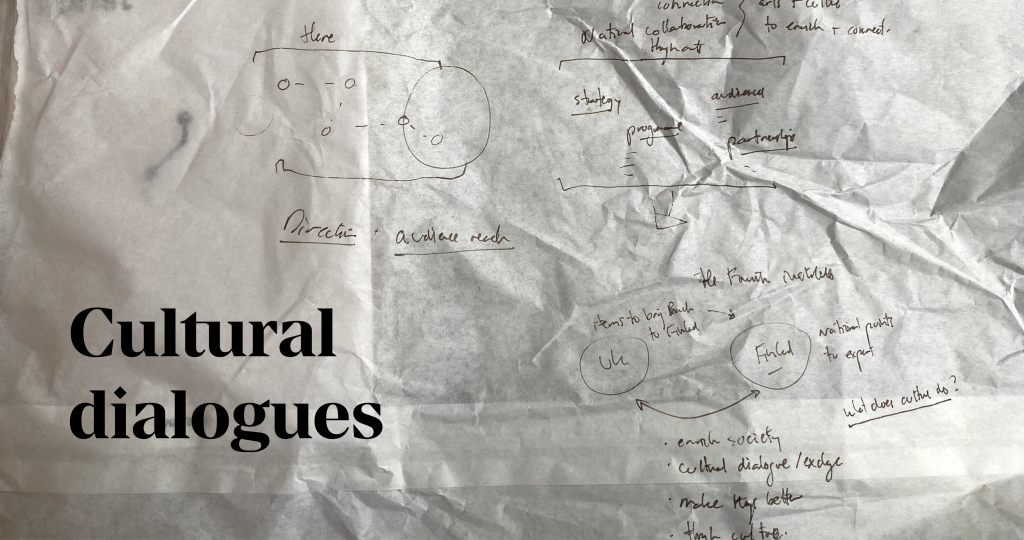
Arts and culture as a platform for dialogue.
We found that arts and culture can create space for dialogue, offering ways to explore complex issues that other sectors can’t approach in the same way. While certain industries focus on systems, scale, growth and efficiency, cultural work is rooted in human experience. It connects people to ideas on both an emotional and intellectual level, raising critical questions in ways that deeply resonate with audiences.
At its most powerful, a cultural institute becomes a forum where perspectives meet. A space where difficult subjects can be touched upon through creative expression. Whether through exhibitions, performances, or public discussions, culture opens topics up to examination from different angles. Possibly creating an understanding that can’t be achieved through policy or industry alone.
The role of design in shaping an institute.
Design is often associated with tangible elements such as visual identity, space, form, but it also operates at a structural level. Shaping how an organisation functions and how it enables people to do their best work. Design is about creating systems that support clarity and focus while leaving room for adaptation. The challenge is finding the balance between ambition and feasibility, ensuring that an institute remains both visionary and grounded within the resources available.
The design of a cultural institute is about elevating the human experience. Creating the conditions where individuals, ideas, and artistic work can reach their full potential. It’s also about national exchange: the movement of ideas, knowledge, and artistic perspectives between cultures. Design shapes the structures that help these exchanges to happen, making them meaningful and impactful.
Looking back to look ahead.
After six years as a board member and Vice Chair, I step away with more questions than I arrived with, which feels right. The Institute faces new contexts that would have been hard to imagine when I joined. The team, the strategy, and the structures are stronger and the real measure of that strength will be in what happens next.
The work we leave behind is not ours to complete. It belongs to those who continue it. How can it continue to create value, not just in what it presents, but in the way it is built and sustained? These are the questions that will continue to shape its design.